

90% Plan to Increase Funding for Compliance Automation, But Only 1 in 5 Have a Strategy to Automate
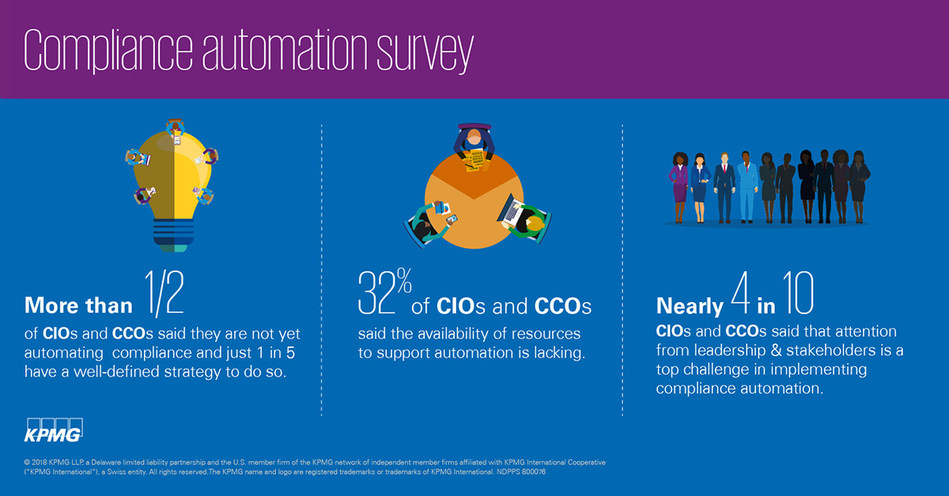
While compliance leaders may understand how automation can help their organizations more efficiently respond to shifting regulatory expectations and the changing risk landscape, more than half of 206 U.S. chief information officers (CIOs) and chief compliance officers (CCOs) surveyed by KPMG are not yet automating their compliance activities, according to the new KPMG report, Innovating compliance through automation. And, while 90 percent plan to increase funding for automation in the coming years, just 1 in 5 have a well-defined strategy to automate compliance in the next two years.
Read More: Interview with Akemi Tsunagawa, Founder and CEO, Bespoke Inc
“Companies are automating routine operational tasks to increase efficiencies and lower costs,” said Amy Matsuo, Principal in KPMG LLP’s Risk Consulting Services and National Leader of KPMG’s Regulatory Insights Practice. “The next step is for organizations to pivot from using automation in operational processes to deploying it for compliance analytic and predictive purposes. To do so, they must first prioritize compliance activities that can be automated while setting expected returns on investment.”
Read More: Interview with Akemi Tsunagawa, Founder and CEO, Bespoke Inc
Obstacles to Automation
- Weak data – When asked what is limiting their ability to automate compliance activities, 70 percent of CIOs and CCOs named data integrity and 67 percent pointed to data availability as leading factors.
- Leadership should be better engaged – About 36 percent of CIOs and CCOs said that attention from leadership and stakeholders is a top challenge they have encountered or expect to encounter in implementing compliance automation.
- Skills and resources gap – Thirty-two percent of CIOs and CCOs said the availability of resources to support automation is lacking. CCOs and CIOs differ on their view of the lack of subject matter knowledge in their organization needed to tackle compliance automation. Approximately 18 percent of CCOs said the subject matter knowledge of the resources completing the automation was lacking while 40 percent of CIOs point to this as a main challenge in automating compliance.
Read More: Interview with Akemi Tsunagawa, Founder and CEO, Bespoke Inc
“Organizations will need to identify personnel with the appropriate skills, knowledge and availability to undertake automation. This requires a unique skillset that blends an understanding of business operations, compliance issues and risk management with technological proficiency,” Matsuo said.
Read More: Millennial Parents Feel More Secured about AI Babysitting their Generation Alpha Kids!